
Tuesday, April 10, 2012
Lizard Project- Fun with Photography, Thanks to Vincent Musi
Some say that a picture is worth a thousand words. I think I have never been more in agreement with that statement than after my day yesterday. Vincent Musi, a world famous photographer, and his family visited us and he took a shot at photographing our lizards. Vince had wonderful stories about his life as a National Geographic and freelance photographer, and after working with him, it was clear he was a master of his trade. Vince had prepared a wonderful lizard studio, and we spend hours with him working on getting the right lizard poses (which is very hard to do in a very unnatural lizard studio). After about 6 hours of work, we finally got a lizard to flare his dewlap in just the right place, at just the right time. Pretty great to see a lizard in such detail, something I could never appreciate with the naked eye! Many thanks to Vince for coming down to work with the lizards! Also, Vince's son Hunter is an expert lizard nooser in training! He had plenty of natural talent!


Thursday, April 5, 2012
Lizard Project- Day 10. Lizard Lingo!
We are on the cutting edge of evolutionary biology, but also on the cutting edge of developing new vocabulary. After spending days and days trying to catch lizards, we have developed some new vocab words. Let me define a few of these words, and use them in a sentence so you can better understand them.
“Squirrel” verb To run around to the backside of a tree to avoid danger coming from the front, as squirrels commonly do to avoid predators.
In common lizard speak: “Hey Dan, did you get that big male?” “Nah, he squirreled me, can you see him from the other side?”
“The Praying Mantis” noun The lizard catching technique generally employed to counter squirreling. When a lizard is unseen, but its location is well known, the lizard-catcher aligns his hands in a prayer position, and then rapidly wraps his fingers around the tree, hoping to capture the lizard on the other side.
In common lizard speak: “Hey Tim, that lizard is directly on the other side of that branch, use the Praying Mantis!” (Video demonstration to come!)
“The Put-back” noun When one lizard catcher should capture a lizard, but fails at the last moment, but another lizard catcher comes in to capture that same lizard before it escapes. This word was borrowed from basketball, when a player simultaneously rebounds and scores off a teammates missed shot. To see a prime example of a putback, see the video:
In common lizard speak: “I can’t believe that dang lizard got away from me when I was getting it out of the noose!” “Yeah, Good thing Reedy was there with the Put-Back, Taj Gibson would be sooooo jealous!”
Wednesday, April 4, 2012
Day 8 & 9: A field day in the life of an evolutionary biologist- repost from Aaron's blog
As a biology teacher it seems to me that many kids who would make really great biologists (Maybe you are one of those kids!), don’t become biologist because they don’t know any biologists personally and can’t picture exactly what it is they would do as a biologist. Here at WideWorldScience we love what we do and we want to share it with you. While it is true that there is a lot of time spent back at the lab, analyzing data, teaching classes, planning experiments and preparing for field expeditions, all of us love to get out and do science in the wild. We really do love working with our friends outside, paddling kayaks, looking for wildlife, climbing trees and chasing lizards. We live for these field trips! Here is a typical field day in the life of a biologist:
6:30 Wake up- Four of us are packed into the tiny bunkhouse room at the Guano Tolomato Matanzas Estuarine Research Reserve. It is small, but it has air conditioning, running water, electricity and an internet connection, so we are glad to have it. Many times we camp in tents while we are working in the field.
6:45 Breakfast- cereal, milk and bananas
8:00 Drive 3 miles to the boat launch- This is where we put the kayaks in the water. There are lots of fisherman that put their boats in the estuary here. It is a busy place.7:15 Packing the gear- We pack up all of our gear into the truck for the day. This includes, lizard nooses, lizard bags, drinking water, dry shoes, sunscreen, cameras, animal coolers, lizard noose repair kit, duct tape (you always need duct tape), life jackets, kayaks, paddles and of course lunch (usually pb&j sandwiches, apples and granola bars).
8:30 Paddle out to the islands- This is one of my favorite parts of the day. It takes about 10 minutes to paddle to Island M, our closest island, and about 45 minutes to paddle to Island F, the furthest island. We often have dolphins swim near us while we paddle.
9:00 We land on an island. This requires us to wade through the shallow water. Since Tim cut his foot on an oyster shell two days ago, we have to help him keep his feet dry. See this video.
 |
| Dan and Andrew with our rental truck and kayak trailer. |
6:45 Breakfast- cereal, milk and bananas
8:00 Drive 3 miles to the boat launch- This is where we put the kayaks in the water. There are lots of fisherman that put their boats in the estuary here. It is a busy place.7:15 Packing the gear- We pack up all of our gear into the truck for the day. This includes, lizard nooses, lizard bags, drinking water, dry shoes, sunscreen, cameras, animal coolers, lizard noose repair kit, duct tape (you always need duct tape), life jackets, kayaks, paddles and of course lunch (usually pb&j sandwiches, apples and granola bars).
8:30 Paddle out to the islands- This is one of my favorite parts of the day. It takes about 10 minutes to paddle to Island M, our closest island, and about 45 minutes to paddle to Island F, the furthest island. We often have dolphins swim near us while we paddle.
9:00 We land on an island. This requires us to wade through the shallow water. Since Tim cut his foot on an oyster shell two days ago, we have to help him keep his feet dry. See this video.
 | ||
The commute to the office. 9:15- 12:15 We hunt for lizards on the island. We just walk around carefully looking for lizards in the trees. When we find one we then try to noose it. We put numbers on those that we have already caught so we don’t catch them again accidentally.  12:15- 12:45 We take a break to eat our lunch. 1:00- 4:00 We move to a second island and catch lizards there.
4:15 We paddle the kayaks back to the boat launch and load them back up on the trailer to drive back to the field station. 5:00 to 6:30 Blogging, Tweeting, Cooking Dinner and updates data notebooks  6:30-10:00 Processing Lizards. This is what we call it when we measure, weigh, mark and take tissue samples from the lizards. ![IMG_0789[1].JPG.jpg](webkit-fake-url://7B832164-BAE7-4224-8DF8-E6EB38434839/IMG_0789%5B1%5D.JPG.jpg) 10:30 Sleep time! We are really tired by this point in the day! |

Lizard Project- Day 7
Each day that we have been working on The Lizard Project has been different, but what all of the days have in common is that we are making progress towards our goal of gathering enough data to make conclusions on whether or not or hypotheses are supported. All of our data collection brings us closer to being able to say something, supported by evidence, about how sex ratios effect the evolution of animal populations.

Since we caught so many lizards yesterday (135! Wow!) we had a huge backlog of lizard measuring, weighing and marking to do. To get everything done we split up the team. Dan stayed back at the field station to do the measuring, while Andrew, Tim and I paddled out to Islands M and K. We worked for 6 hours total, but only caught 47 lizards today. Many of the lizards we spotted today were already marked. That is a good sign because it means we are already getting close to having all of the animals captured, marked and measured on a couple of our islands. We also had a great Skype conversation with Erin Nash's Zoology class. The Benton High School students had great questions for us and the whole thing was a lot of fun.
While we are down hear working the pace can be grueling at times. The work on the islands is often very hot and we often work late into the night measuring lizards. Crawling around in the trees and bushes chasing after lizards leaves us scratched up and bruised. Yesterday Tim got even more scratched up while getting back into his kayak. He accidentally stepped on a razor sharp oyster shell and cut his foot.
Throughout all of the work that we do with the lizards, one of the greatest perks of our job is working in such a beautiful setting with so many cool animals all around us. The insect communities on the islands are amazing and would be worthy of an entire research project on their own.
Since we caught so many lizards yesterday (135! Wow!) we had a huge backlog of lizard measuring, weighing and marking to do. To get everything done we split up the team. Dan stayed back at the field station to do the measuring, while Andrew, Tim and I paddled out to Islands M and K. We worked for 6 hours total, but only caught 47 lizards today. Many of the lizards we spotted today were already marked. That is a good sign because it means we are already getting close to having all of the animals captured, marked and measured on a couple of our islands. We also had a great Skype conversation with Erin Nash's Zoology class. The Benton High School students had great questions for us and the whole thing was a lot of fun.
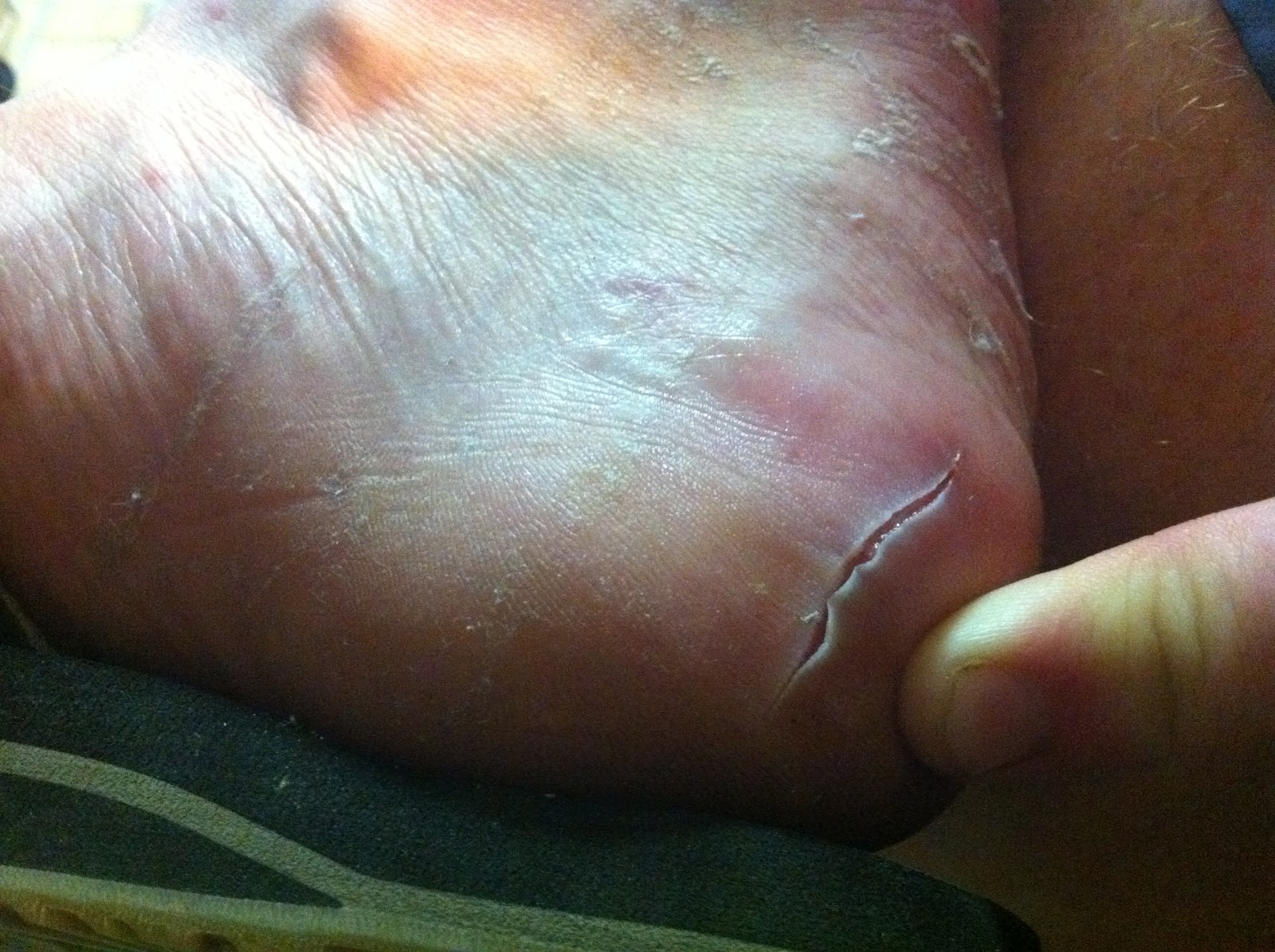 |
| Oyster beds are sharp - ouch! |
Throughout all of the work that we do with the lizards, one of the greatest perks of our job is working in such a beautiful setting with so many cool animals all around us. The insect communities on the islands are amazing and would be worthy of an entire research project on their own.
Sunday, April 1, 2012
Lizard Project Day 6- Lots of Lizards!


On a side note, I had the most terrifying moment of my life yesterday. After the rains, I went for a run and then swim in the ocean. As I was swimming, I noticed two HUGE shark fins cruising towards me. I turned and swam/ran/stumbled my way back onto the beach. They came within 10 meters of me. Their dorsal fins were about 18-24 inches tall, and was about 6 feet in front of their tails, which was also breaking the surface. This means these sharks were probably about 12 feet long. I never saw the heads, just the fins and tail, so I don't know what species they were, but based of their size, I certainly could have been on the menu. Turns out Florida has had the most shark attacks of any state in history, according to the Florida Museum of Natural History... I won't be swimming anytime soon.
Saturday, March 31, 2012
Days 4 and 5 of the Lizard Project- repost from Aaron's blog
We are already into day 5 of The Lizard Project. Our team is settling in to our daily routine of working in the field, When it comes to science in the field, nothing is ever really routine.
Yesterday, was a really full day. We left at 6:00 am to get our rental pickup truck. This is great for us, because we can now pull a trailer with all four of our kayaks and carry all of our gear in the back, all in one trip.
We did four Skype video calls with classrooms. The first call was to Adam Taylor's class in Nashville, TN at Overton High School. They asked lots of great questions and Mr. Taylor even ran a live webcast of our conversation! We then talked to 3 of Mr. Will Reed's classes at Kelly High School in Chicago. The first conversation actually took place from the water while we were paddling the kayaks out to the islands! We had hot sunny weather and it was a great day for the lizards. We caught 76. Tim also became a legend among our crew when he caught a bumble-bee out of mid air with his lizard noose. If you don't understand why that is amazing, check out this quick video of a lizard noose in action. http://bit.ly/HszCIG Now picture using that to catch a bumble bee in mid-air.
Today mother nature dealt us a completely different day to work with. We got out to the islands around 9:00am, but it was cool and windy with storm clouds threatening. We worked at catching lizards for 4 hours total on three different islands and only caught 6 lizards. Lizards are ectothermic or what you might know as cold-blooded. Because they are ecothermic, they can't move very fast when they are cool. So on days when it is not sunny and hot, they spend most of their time hiding inside of trees or underneath palm fronds. They are almost impossible to find under these conditions and we only found a few. We decided that any more time spent searching for hidden lizards was not worth it, the sky grew more threatening and we spotted lightning. That was our cue to head for home. We hurried to load up our gear in the boats and paddle for the dock. We paddled with a huge wind at our backs and loaded the kayaks onto the trailer just as the rain and hail hit. No we are back at the field station catching up on data processing and waiting out the rain.
Aaron Reedy
Yesterday, was a really full day. We left at 6:00 am to get our rental pickup truck. This is great for us, because we can now pull a trailer with all four of our kayaks and carry all of our gear in the back, all in one trip.
 |
| Tim caught a bumble bee with a lizard noose. No way! |
 |
| Threatening Sky |
Aaron Reedy
Lizard Project Day 4 and 5
Day 4 was a busy day. We, picked up a truck which makes transporting kayaks easier, caught 76 lizards on 2 islands, released lizards from the previous day on 2 islands, and skyped with 4 different classrooms. We also processed (weighed, measured, photographed, and marked) a ton of lizards. On day 4 it was very sunny, which made for active lizards. This both helps us (as lizards are out and about) and hinders us (as the lizards are really hard to catch). The lizards become hard to catch because they are ectothermic, and in warm temperatures they are operating close to their optimal body temperature, which makes them very athletic. Still, we managed to get a lot of them.
Today is Day 5 (Saturday). Today it was very cool and overcast, and we found very few lizards in the morning (only 6 captured in total). In the early afternoon, it started to storm, so we got of the islands as quickly as possible and made it back to shore just before a huge rain, lightning, and hail storm. So now we are catching up on other work.
Today is Day 5 (Saturday). Today it was very cool and overcast, and we found very few lizards in the morning (only 6 captured in total). In the early afternoon, it started to storm, so we got of the islands as quickly as possible and made it back to shore just before a huge rain, lightning, and hail storm. So now we are catching up on other work.
Lizard Project- Day 3 videos
We had a busy Day 3! Here are videos of the Island Glass lizard we found, how we capture lizards, and how we measure dewlaps!
Thursday, March 29, 2012
Lizard Project- Day 3. The little things.
One of the best parts about doing research in the field is the little unexpected things that you get to see because you are spending time looking at nature so carefully. Today we got a lot of work done. We measured dewlaps in the morning for 20 lizards, paddled out to islands M and K where we caught 76 more lizards, took a break for dinner and then measured, weighed and marked our catch. We did a lot of work, but the things I will remember about today were the little things that happened in between the work.
 While paddling between islands in our kayaks, we saw a snake swimming out in the middle of the estuary. We paddled over to try and catch it. Once Tim had it in hand, we realized that it wasn't a snake at all. It was a eastern glass lizard, a species of lizard without legs. It is a great example of convergent evolution. They look like snakes, but they evolved this body completely independently. None of us had ever seen one in real life (aka: the wild) before.
 The other fun part of the day occurred as we chased down a large male anole. Aaron spotted the anole in the tree, and it was eating the lunch of a fat spider. Tim then tried to catch the anole with his lizard noose but accidentally caught the spider instead. The seconds later, Dan caught the lizard.

 While paddling between islands in our kayaks, we saw a snake swimming out in the middle of the estuary. We paddled over to try and catch it. Once Tim had it in hand, we realized that it wasn't a snake at all. It was a eastern glass lizard, a species of lizard without legs. It is a great example of convergent evolution. They look like snakes, but they evolved this body completely independently. None of us had ever seen one in real life (aka: the wild) before.
In the middle of working on the islands, we heard loud snorting and slapping noises. In the estuary, we saw several dolphins swimming in the shallows. Quite a site to see for us, since we all live in the midwest, nowhere near an ocean.
 The other fun part of the day occurred as we chased down a large male anole. Aaron spotted the anole in the tree, and it was eating the lunch of a fat spider. Tim then tried to catch the anole with his lizard noose but accidentally caught the spider instead. The seconds later, Dan caught the lizard.
We are looking forward to more of the little things. -Tim and Aaron
Wednesday, March 28, 2012
Lizard Project- Day 2


LIzard Project- We have arrived in Florida
Here is a little info about our first day in Florida. Stay tuned, as we head out to our Islands on Day 2 for the first time since last August. We can't wait to see what is out there.
Millie, the snake in Mr. Morris's Class is also a Corn Snake. This one is a lot younger, and cruising around in the wild, though!
Thursday, March 22, 2012
Dan "The Lizard King" Warner
I have learned a tremendous amount from Dan Warner, who is currently a post-doc in Fred's lab. As you know, I am very interested in sex-ratio evolution (see "Why I study Turtles?" post). And so is Dan. Dan has developed a very big and intriguing project on sex ratio evolution using on islands in Florida. I am going on my second trip to Florida next week with Dan to continue work on the project.
Here is a little bit about Dan. You will be hearing much more from us in the near future!
Monday, March 19, 2012
Tweet tweet!
In order to correspond with students and anyone else interested when I am in the field, I have just opened a twitter account. @timsturtles is my username. Start following, as our Lizard Project adventure starts next week!
Friday, February 24, 2012
Follow up to the paper discussion: Reedy's students check this post out
Hi Mr. Reedy's students,
Great work tackling this scientific paper. Reading and comprehending these sorts of papers is always a challenge to start with, and gets easier with practice. Remember that the authors anticipate their audience to be experts in the field, so that is why it may seem hard to read if you are just starting to learn about this stuff!
I really enjoyed reading your answers and you seem to be very much thinking in the right way. I tell you what I was thinking about these discussion questions.
Discussion Questions.
3) In this experiment, the authors discovered that smaller male beetles were substantially better at finding females than larger male beetles, particularly at cool temperatures. However, finding a mate is just one part of this beetle's life. Do you think it is always better to be smaller for these male beetles? Can you think of other parts of a beetles life where it might be advantageous to be larger? Do you think it is better for females to be smaller as well?
My Answer: Certainly there could be many life stages or situations where it is not advantageous to be smaller. Yessenia brought up a nice point about bigger females being able to have more offspring. This is called fecundity selection- often larger females can have more (or bigger) offspring, which may increase their fitness. Also, many of you recognized no predators were in this experiment, and predators may be able to attack smaller beetles better. We don't actually know if this is the case, but could probably design an experiment to try and figure out. Also, these beetles have something called nuptial gifts (the authors wrote about this in the beginning). Males offer females a gift at the time of mating, and females like bigger gifts, and bigger males can make bigger gifts. And do you know what the gift is? Beyond just giving the female sperm at mating, the male ejaculate contains a nutrient rich substance that the female eats!!!! Yep, females like to eat the male's large ejaculates, and it actually helps them nourish their offspring! Pretty awesome, huh!

Great work tackling this scientific paper. Reading and comprehending these sorts of papers is always a challenge to start with, and gets easier with practice. Remember that the authors anticipate their audience to be experts in the field, so that is why it may seem hard to read if you are just starting to learn about this stuff!
I really enjoyed reading your answers and you seem to be very much thinking in the right way. I tell you what I was thinking about these discussion questions.
Discussion Questions.
3) In this experiment, the authors discovered that smaller male beetles were substantially better at finding females than larger male beetles, particularly at cool temperatures. However, finding a mate is just one part of this beetle's life. Do you think it is always better to be smaller for these male beetles? Can you think of other parts of a beetles life where it might be advantageous to be larger? Do you think it is better for females to be smaller as well?
My Answer: Certainly there could be many life stages or situations where it is not advantageous to be smaller. Yessenia brought up a nice point about bigger females being able to have more offspring. This is called fecundity selection- often larger females can have more (or bigger) offspring, which may increase their fitness. Also, many of you recognized no predators were in this experiment, and predators may be able to attack smaller beetles better. We don't actually know if this is the case, but could probably design an experiment to try and figure out. Also, these beetles have something called nuptial gifts (the authors wrote about this in the beginning). Males offer females a gift at the time of mating, and females like bigger gifts, and bigger males can make bigger gifts. And do you know what the gift is? Beyond just giving the female sperm at mating, the male ejaculate contains a nutrient rich substance that the female eats!!!! Yep, females like to eat the male's large ejaculates, and it actually helps them nourish their offspring! Pretty awesome, huh!

Could spiders (or beetles) ever get this big??? Thanks to evolutionary constraints, they probably cannot! As Mr. Reedy knows, spiders are not my favorite animals, so I am particularly grateful to these constraints for this reason. He can probably tell you some good stories about my Arachnophobia...
4) Suppose that we went and found some beetles in their natural habitat, studied them for a year, and found that in every situation, it was better to be larger. What do you think would happen over a very long time (many thousands of generations)? Would we find beetles as big as a human some day?
You guys came up with some pretty good answers to this one too! If there is strong selection for beetles to be larger, they will evolve to be larger. In fact, the authors had already artificially produced larger and smaller strains. However, just because during one year, it was better to be larger, doesn't mean that it would consistently be better to be larger. Maybe the climate in the year of the study favored larger beetles. Or maybe the optimal beetle size is just slightly larger than they are now. Then we would expect selection to favor larger ones until they reach this size, but then when they get bigger than the optimal size, selection would favor smaller beetles. Julia brought up a great point, too. She thought that the structure of the beetles exoskeleton might limit how large the beetle can get, and she is probably right. You never find spiders or beetles, or many other invertebrates over a certain size, because of what we call constraints. For example, beetles have very different respiratory and circulatory systems than mammals do, and wouldn't likely be able to support such a large body size with the limitations imposed by theses systems.
Wednesday, February 22, 2012
Upcoming trip to Florida. Stay tuned!
 I am heading to Florida at the end of March to work on a evolutionary ecology project with Dan Warner and Aaron Reedy. We will be studying sex-ratio selection, sexual selection, natural selection, and the population ecology of Brown Anoles. They are a really great animal to study and also look pretty sharp (see the picture at left by Dan). Check out this link to Aaron's blog to learn more!
http://wideworldscience.blogspot.com/2012/01/do-you-want-to-connect-your-classroom.html
Monday, February 13, 2012
Mr. Reedy's Students- Read this!

Hello Mr. Reedy's students! You may remember me as that guy who came to your class to talk about turtles in December, or you may remember me as Mr. Reedy's BFF (I know are curious who Mr. Reedy's best friend forever is, and now you know). You also may remember I am a scientist at Iowa State University, and that I work with a Middle School classroom in Des Moines, Iowa. We are hoping that our classes are going to get to know each other, and share our science experiences with each other over the coming months.
I believe that you are knee deep in your animal behavior studies at this point, and we would like you to read about an experiment with seed beetles published in a peer reviewed journal (check them out in the photo by CW Fox). When scientists do research, they share that research through posters, talks, and through papers. For a paper to be peer-reviewed, it means the paper was critically examined by other expert scientists. The paper could be published only after these other scientists approved of the experimental design, statistical analyses, and the conclusions drawn by the authors. The paper we would like you to read is titled "Smaller beetles are better scramble competitors at cooler temperatures."
Mr. Reedy should have given you a copy in class. What I would like you to do is answer the following 4 questions. Please write them as comments to this post!
Mr. Reedy should have given you a copy in class. What I would like you to do is answer the following 4 questions. Please write them as comments to this post!
Moya-Laraño J, M El Tigani El-Sayyid & CW Fox. 2007. Smaller beetles are better scramble competitors at cooler temperatures. Biology Letters 3: 475-478.
Comprehension:
1) These authors designed an interesting experiment to help answer some questions they had. After reading this paper, in your own words, write what question or questions motivated this experiment.
2) Figure 1A shows that most of the selection differentials are negative. What does that mean?
Discussion:
3) In this experiment, the authors discovered that smaller male beetles were substantially better at finding females than larger male beetles, particularly at cool temperatures. However, finding a mate is just one part of this beetle's life. Do you think it is always better to be smaller for these male beetles? Can you think of other parts of a beetles life where it might be advantageous to be larger? Do you think it is better for females to be smaller as well?
4) Suppose that we went and found some beetles in their natural habitat, studied them for a year, and found that in every situation, it was better to be larger. What do you think would happen over a very long time (many thousands of generations)? Would we find beetles as big as a human some day?
Friday, February 10, 2012
Exploring the different ways scientists work: Mt St Helens

In 1980, Mount St. Helens in the state of Washington erupted. In class today we looked at how scientists in two different disciplines studied the Mount St. Helens eruption. A group of Geologists from the United States Geological Survey were very interested in the mechanics of the eruption, and why the mountain exploded the way it did. The eruption eradicated almost all life in a 230 square mile area north of the mountain. Ecologists were very interested in how plant and animal communities recolonized this lifeless, ash-covered area. Neither of these scientist teams did experiments, but instead studied what naturally happened, and learned a lot from it. Read the post before where I clarify the difference between experiments and studies.
If you are interested in learning more about these studies, check out the links below.
Here is an account of the blast from the USGS.
http://www.youtube.com/watch?v=xP2dreOI8gI
This ecologist studied the change in plant and animal communities since the blast.
http://www.pbs.org/wgbh/nova/nature/crisafulli-blast-zone.html
Monday, February 6, 2012
State of the Union

Sunday, January 29, 2012
Where does your electricity come from?
The plug? Batteries? Wires? Power lines? The light switch? Yes and No. These are all parts of our infrastructure for transporting and using energy in ways that are convenient to us. But this is not how our electricity is generated. Going around the classroom, we generated a pretty good list of energy sources. The thing that came to mind first for most students was usually solar panels, wind turbines, and hydroelectric dams. Some thought of ethanol and geothermal energy as well. Not many thought of nuclear energy as an important source. Most students had heard of and knew that various fossil fuels (coal, oil, natural gas) were also used. However, when we asked students to make pie charts of where our electricity came from, very few expected fossil fuels and nuclear energy to be as important of a source of electricity as they really are.

Now, when we start thinking about what else we use fossil fuels for, it becomes a bit scary. Most of the agriculture in the state of Iowa is dependent on fertilizers derived from fossil fuels. Our transportation system, whether we are talking about trains, planes or automobiles is dependent on fossil fuels. And electric cars? Where does that electricity come from? Fossil fuels again. How do we transport our fruits and vegetables from California, Brazil, Florida, etc. to the grocery store? How do we keep our dairy products cool in the store and in our home? How do we heat our homes? And does our military use fossil fuels? You can be certain that tanks, ships, planes, and humvees use their fair share of fossil fuels. What about plastics? You have never heard of a plastic mine before, but I am sure you have heard of an oil rig... Thats right, plastic comes from fossil fuels too!
It is clear that our country and lifestyle is highly dependent on fossil fuels, which are not renewable, and are going to run out sometime in the not to distant future. This week we will watch a part of President Obama's State of the Union Address, to see what he has to say about our energy problems and have a discussion about it, and start talking about the sorts of things scientists are doing to address these global problems.
Science Fair was a success!
On Thursday evening, students presented their research to teachers, parents, administrators, guests and each other. It was an exciting event. We had some great and original projects, asking a diversity of questions. One student measured plant growth of three different species on five different soil types. I was impressed to see this replicated factorial design! Another project explored bacterial diversity in from areas around their house, and their pets' saliva. A third tried to investigate whether larger chicks hatch from larger eggs- while that project didn't quite work out for them, I was excited to see some maternal effects research at the seventh grade level! They plan to repeat the study to see if they get successful hatching this time. All the students engaged visitors to their posters and informed them about their projects.
Subscribe to:
Posts (Atom)